Recently, I was invited to speak to a group of change consultants and change managers. Now, I’m not a change consultant myself – I’m a video maker. But, having spent my career making films for learning and development, “…I’ve ended up specialising in something that’s very much at the heart of their work: behaviour and culture change.
I shared the story of how I developed Drama for Change – a method that uses video drama to shift behaviour in organisations – and why the science behind it is relevant far beyond the world of film.
Where it all began
I started my career in video art – with my work shown at the ICA and MoMA by the age of 22. But I left the art world, disillusioned with its value system, and moved into corporate video. It seemed more honest, and I liked the craft aspect of making whole films myself. When eLearning (or “multimedia”, as it was called in 1996) arrived, I found a natural fit – especially as it allowed me to make drama, which I love.
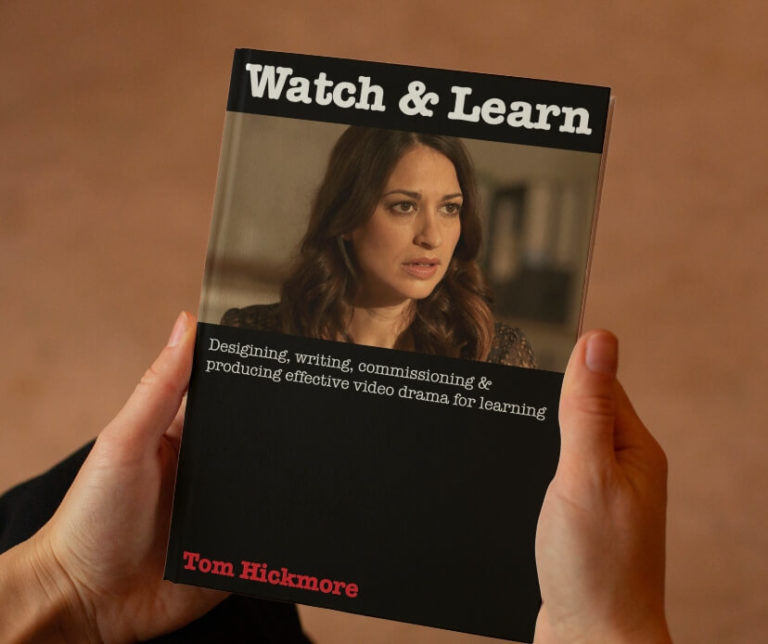
Over time, however, I grew frustrated. Too often I was asked to produce video dramas based on weak ideas – scenarios created by learning designers without much understanding of storytelling or the medium. So during lockdown, I wrote a book: Watch & Learn, which set out the fundamentals of how to do drama well in this context.
That led to podcasts and speaking gigs – and made me ask: what is the most powerful and effective way to use drama in the corporate world? The result was the Drama for Change method.
The science behind storytelling
At a high level, Drama for Change uses drama to spark reflection and discussion, then reinforces this through a campaign. But to understand how it works, it helps to know why stories are so effective.
A 2016 study led by neuroscientist Jonas T. Kaplan found that when people are presented with information that challenges their deeply held beliefs, their brains respond as though under physical threat. The fight-or-flight system kicks in – not great when you’re trying to change behaviour at work.
But storytelling short-circuits that threat response. When we hear a story – especially one featuring someone facing a challenge we can relate to – our brains behave as if we’re experiencing the events. That’s empathy in action. And that’s why stories are so powerful in encouraging behaviour change.
What monkeys can teach us about group dynamics
Another strand of research I find fascinating comes from evolutionary psychologist Robin Dunbar. His starting point was a puzzle: among primates, species with larger brains tend to live in larger social groups. Was there a direct correlation between brain size and the size of the group an animal could maintain?
Dunbar studied a range of monkeys and apes and discovered that it wasn’t just total brain size that mattered – it was specifically the size of the neocortex, the part of the brain responsible for higher-order thinking and social behaviour. The bigger the neocortex, the more individuals an animal could manage relationships with.
From there, he applied the same logic to humans. Using the average size of the human neocortex, he calculated the number of stable, meaningful relationships a person could maintain. The answer? Around 150 – what has since become known as the Dunbar number.
He backed this up by looking at everything from the average size of villages in the Domesday Book, to company sizes, to Christmas card lists and Facebook friends. The number 150 came up again and again.
Among non-human primates, social cohesion is maintained through grooming – an activity that releases endorphins, builds trust, and helps the group stay bonded. But grooming is time-consuming, and there’s a limit to how many individuals you can groom in a day. Dunbar calculated that if humans tried to maintain group bonds this way, we’d need to spend 43% of our waking hours grooming each other – clearly not feasible.
So, what did we evolve instead?
How humans hold groups together
Dunbar identified that humans developed more efficient, scalable forms of bonding. Activities like laughter, music and dance, religious ritual, and storytelling serve the same social purpose as grooming – they release endorphins, create shared identity, and help maintain group cohesion.
You’re unlikely to include religious ritual or a dance circle in your next workplace change initiative, of course. But it’s worth noting that change is a social process, and these bonding behaviours reflect the part of us that navigates the world through relationships, emotions, and shared narratives. That’s the part Drama for Change speaks to.
The evolution of gossip
One bonding behaviour we all engage in – often guiltily – is gossip. Gossip is storytelling in action: it’s how we negotiate social norms, talk about behaviour, and make sense of right and wrong in a group. It combines many of those evolved bonding behaviours: laughter, narrative, shared values.
Drama, when used well, plugs directly into this. It gives people a shared reference point: a character they can talk about behind their back – safely, because they’re fictional. I call this mechanism The Gossip Engine.
A practical example: training bus drivers
One of our most successful projects used this principle to reduce collisions at a bus company – a classic behavioural challenge. We created a series of short comedy videos featuring a likeable but flawed driver named Dom, who dispenses advice in an overconfident tone.
Each video ends with a moment of decision – encouraging drivers to discuss what they’d do in the same situation. According to the Training Manager:
“The scenarios very much promote discussion… they come up with some very good options without us having to tell them.”
The Gossip Engine kicked in. The videos were used in training sessions and shared on their internal comms platform, where they consistently achieved over 80% engagement. We followed up with a series of videos in the style of Gogglebox, showing real drivers reacting to the original content. This extended the learning and kept the conversation going over time.
That campaign – along with others addressing sexual harassment and customer experience – helped the company win a UK Bus Award for culture change, with “training through dramatized storytelling” cited as a key factor.
So what’s the takeaway?
People resist change because they feel threatened – even when the change is logical, well-argued, and backed by policy. But drama, rooted in the science of empathy, identity, and social bonding, can help bypass that resistance.
If your messages are being ignored – and your posters and policies are falling flat – it might be time to try a different kind of story.